Pacifica Tribune, "My Turn" Guest Column, 7/17/12. "Our environment should be our economy" by Samuel Casillas
 |
| This is our economy, Sam |
"There
is no question that Pacifica is at a critical juncture in its economic
evolution. Yes,
our economy continues to struggle in the wake of a
recession that, I believe, we all must bear some responsibility for.
Yet, I feel that during this time of crisis, we must not succumb to fear
and ignorance which can easily drive our community into petty bickering
that does not serve our city in the least. Together, we must look at
this time as an opportunity to transform our great city into a
self-sustaina
ble model of economic growth that develops in unison with
our core principles and preserves all that we care about in Pacifica.
 |
| Hiking our hills, not so much |
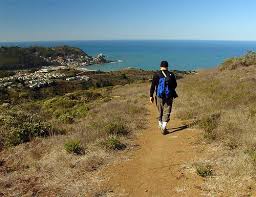
This
city was founded on the principle of a family-based community that
lives in harmony with the beauty of the surrounding environment which
encompasses emerald hills falling into the majestic Pacific Ocean.
I
strongly believe that our town's stunning beauty directly impacts the
physical health and mental well-being of our citizens. Pacifica's
beaches and coastal vistas are arguably some of the most
stunning
landscapes in
Northern California and we are very privileged to have
this to recreate in and gain solace from in the hustle and bustle of our
daily work lives.
Our environment also turns out to be our greatest
potential economic asset that should be developed to ensure our
viability as we look to the future.
Soon after Pacifica was incorporated, we lost our way and became a bedroom community for San Francisco; we
became an inexpensive
option for living outside of the city of San Francisco that contributed
to the blight of strip malls and tract housing which dominate the
American landscape to this day.
 |
| Hard on our environment? |
Some would think the answer to
our economic woes is to actually build more residential subdivisions
and bring in big box stores. This is not the answer. Countless studies
(including Conservation Financing Comes of Age, R. Stapleton, 2001
and
and www.lta.org/public policy/landvote2001.htm) actually demonstrate that t
he opposite is
actually true: for every $1.00 in taxes a household brings into the city
budget, $1.26 is spent on services that a household uses including
police, fire and sewer. For every $1 in taxes there is only 54 cents
spent on open space and farmland. That means there is a profit of 46
cents on undeveloped land. As for big box stores, look at the vast
expanses that used to be car dealerships and Circuit Cities in places
like Colma and Daly City. Today they are asphalt deserts.
 |
| Our economy is our dog off leash fine |
In
Pacifica there is actually a much higher cost to households when you
consider the large volume of unauthorized in-law units that put a huge
burden on our sewer system and do not pay into critical services like
sewer, fire, etc. or pay their planning fees and taxes. Again, the
major reason these multiple-unit houses keep cropping up is that it is a
cheaper alternative to living in San Francis
co, yet the
lure of the
City, only being a few minutes away, is where all of us "go over the
hill" to get our entertainment and buy cheaper goods at the big box
stores. The fact is that our hotels even market on the premise that we
are cheaper to stay in than San Francisco.
The fact is that no amount of
additional housing in Pacifica would have ever saved Pacifica Lumber or
other like businesses; we all go over the hill to get less expensive
commodity goods.
So then, how can
Pacifica move our economy forward? The answer is that our environment
should be our economy. Our unrivaled open space in Pacifica can and does
attract hikers, bikers, surfers and others who enjoy the outdoors. But
we need to do a better job of promoting our natural beauty to more
potential tourists and then find ways to keep those visitors here once
they arrive.
 |
| This one we agree on |
That would require us to transform our economy into a
visitor-based economy that capitalizes in the one area that Pacifica
holds a differentiated strength versus other Bay Area communities: our
open space. Many volunteers and dedicated city officials have had, and
still hold to, a true bold vision of what Pacifica can be and they have
laid the groundwork for Pacifica to move forward in this endeavor. We
need to continue to build on the vision of the coastal trail and build a
business-minded strategy that incorporates and takes advantage of the
Devil's Slide parkland that will be our inheritance and our gift to
future generations. The tourists that come to hike in the Pedro Point
Headlands and take in the views from Devil's Slide will be the ones who
add to the revenue base, not only for the Ped
ro Point Shopping Center,
but potentially in a commercial recreational space in Pedro Point that
is currently an open lot and in the Linda Mar shopping center, Rockaway,
Vallemar and the rest of our business districts.
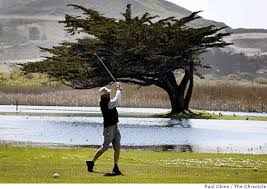
We need to preserve
the Sharp Park golf course that generates 55,000 rounds of golf a year
with 70 percent of those rounds played by residents of other counties,
but we need to find ways to keep those golfers here after they have
played their rounds of golf. The planned Palmetto Streetscape has the
potential to re-invent a business district that can transform into a
vibrant visitor-based shopping district that spills into Mori Point and
our Beach Boulevard promenade.
 |
| Return from visiting our over the hill economy |
I applaud the reluctance of our
city council to hand over the old sewer plant site to housing developers
and instead wait until the right projects come our way that will
actually boost our economy; doing otherwise is how we end up with
apartment buildings in the prime business district gateway of Palmetto
and with a Taco Bell on Linda Mar Beach instead of a Sam's Chowder House
and potentially more run-down apartments along the Beach Boulevard site
instead of a potential Half Moon Bay Brewery- like restaurant across
from our beloved Pier.
We are at a critical crossroads in the
economic life of our picturesque city. The question is,
do we want to
look like Daly City with their green hills carved up and covered in
miles of asphalt parking lots and monolithic billboards covering once
majestic vistas or do we want to be a model for the state and the
country, where we can demonstrate that we can live in harmony with the
environment, while harnessing its economic potential, and protect the
vulnerable wildlife while nourishing our own healthy existence?
Our
environment can, and should, most definitely be our economy. With
vision, leadership, and policies that support its development we will
create a win-win situation for Pacifica -- a vibrant economy based on
our environmental assets- and a healthier future for generations to
come." ***
End
Note: Comments about the household tax benefits. Embedded in the article the Land Trust Alliance link doesn't seem to work, but neither does the argument: "for every $1.00 in taxes a household brings into the city
budget, $1.26 is spent on services that a household uses including
police, fire and sewer." Until proven otherwise this repeated ECO-NIMBY argument as it applies to this city appears to be completely false.
The argument may work better in a rural farmland community, not in this city in this metropolitan area. There were blog conversations, including some research from about 5/30 until 6/1,2012. See articles Recall, 5/22/12, and County and City Parcel Tax Funding, 5/31/12.
REALITY, our parcel taxes returned from San Mateo County to our City General Fund for fire, police, paramedics and other city services amount to 17% of what property owners paid. But in this city, that 17% represents 39% funding of our total City General Fund budget. Sewer taxes are separate, parcel owners pay these taxes directly to our City Enterprise
Fund, and that impact to the city should be more or less neutral.
One thing we can agree on Sam, we should keep San Francisco Sharp Park golf course, however that choice is ultimately not ours.
Posted by Kathy Meeh


